


In the advanced sectors of occupational safety, sports medicine, and industrial thermal management, mitigating physiological heat stress is a critical imperative. Advanced wearable cooling technologies offer passive, reliable temperature regulation that safeguards both productivity and human health in extreme environments. For global procurement officers and safety distributors, understanding the precise maintenance protocols of these tools is essential to maximizing Return on Investment (ROI) and ensuring structural longevity. This technical paper analyzes the material engineering and lifecycle maintenance requirements of industrial-grade cooling wearables, starting with the widely adopted Reusable Ice Ring Neck Cooler, which has become a staple in modern heat-stress prevention protocols.
1. Thermodynamic Mechanisms and Material Encapsulation To execute proper maintenance, one must first distinguish the underlying thermodynamics of the device. The pinnacle of current thermal management is Phase Change Material (PCM). Engineered devices like the PCM Neck Cooling Ice Ring operate on the principle of latent heat of fusion. The bio-based PCM is hermetically encapsulated within a high-density TPU (Thermoplastic Polyurethane) casing via High-Frequency (HF) seamless welding. This zero-porosity exterior requires specific cleaning protocols: it must only be wiped or rinsed with cool water and mild biocides. Exposing the TPU to industrial solvents, bleach, or boiling water can degrade the polymer's elasticity and compromise the hermetic seal.
2. Managing Evaporative Cooling Alternatives In contrast to closed-loop PCM systems, evaporative technologies require a different maintenance approach. Solutions such as the Water Cooling Neck Warp utilize highly absorbent PVA (Polyvinyl Alcohol) or microfiber matrices that rely on the latent heat of vaporization. Because these materials physically absorb water from the environment, they must be thoroughly air-dried in well-ventilated spaces after deployment. Trapping a damp evaporative warp in a dark, unventilated environment will catalyze microbial and fungal growth. Furthermore, mechanical stress-such as aggressive wringing or machine drying-can physically tear the absorptive matrix, permanently reducing its water-retention capacity.
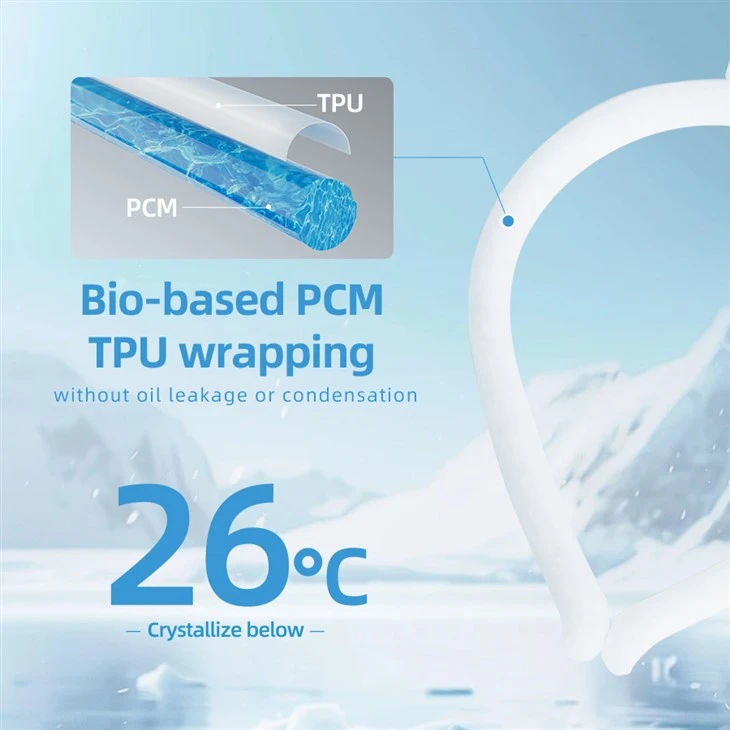
3. Reactivation (Charging) Protocols A fundamental mechanical reality of PCM is its reliance on environmental temperature differentials for reactivation. When the PCM has fully liquefied after absorbing metabolic heat, it must be recharged. The optimal method is exposing the ring to temperatures below its phase-change threshold (e.g., placing it in an ice-water bath, commercial freezer, or air-conditioned room). It is a thermodynamic impossibility for extreme freezing temperatures to damage the PCM; deep cold merely accelerates the crystallization process. However, operators must exercise caution when removing a deeply frozen ring: the TPU casing temporarily becomes more brittle at sub-zero temperatures and should not be violently twisted or bent until it acclimates slightly to ambient conditions.
4. Storage and Structural Integrity Maintenance The structural integrity of a cooling ring dictates its operational lifespan. Under no circumstances should compromised seams be repaired using needle and thread, as puncturing the TPU will instantly destroy the airtight vacuum and cause irreversible chemical leakage. If microscopic abrasions or leaks occur due to sharp workplace hazards, the unit is structurally compromised and must be decommissioned. For long-term storage, cooling rings must be kept in cool, dry environments away from direct Ultraviolet (UV) radiation, which can accelerate the photo-degradation of the TPU polymers.
Conclusion and B2B Procurement The lifecycle and efficacy of reusable cooling rings are directly correlated to strict adherence to material-specific maintenance protocols. By understanding the thermodynamic and structural engineering behind these devices, facilities can ensure their thermal management gear performs flawlessly across countless cycles. As a premier source manufacturer, we engineer our cooling solutions to withstand the harshest industrial and environmental variables. We invite global distributors, occupational safety organizations, and retail brands to consult our technical engineering team for bulk procurement strategies and OEM-customizable thermal management solutions.