

Phase change materials (PCMs) are a class of materials that can absorb or release large amounts of energy (i.e., phase change enthalpy) during a phase change. Because PCMs utilize latent heat to store energy, they offer high heat storage density, compact thermal storage devices, and maintain essentially constant temperature during the phase change process, making them easy to manage. With the growing global awareness of energy conservation, this characteristic of PCMs has attracted the attention of researchers, and PCM thermal storage technology is increasingly gaining traction in the energy storage field.
I. Introduction to Material Technology Characteristics
Broadly speaking, thermal storage technologies include heat storage and cold storage, including sensible heat storage and phase change storage. Sensible heat storage utilizes the material's inherent specific heat capacity to store and release thermal energy, while phase change storage utilizes the absorption and release of heat energy during the phase change of PCMs (phase change materials). PCMs, with their high heat storage density and minimal temperature fluctuations during charge and discharge, have attracted widespread attention from scholars both domestically and internationally. At present, phase change heat storage materials mainly include organic, molten salt, alloy and composite materials. There are four main phase change forms: solid-solid, solid-liquid, solid-gas and liquid-gas.
An ideal solid-liquid phase change material should have the following properties:
(1) High latent heat of fusion, so that it can store energy or release more heat during phase change;
(2) Appropriate phase change temperature to meet the needs;
(3) Good reversibility of solid-liquid phase change, which can avoid overcooling or overheating as much as possible;
(4) Large thermal conductivity of solid-liquid phase;
(5) Small expansion and contraction during solid-liquid phase change;
(6) High density and specific heat capacity of phase change materials;
(7) Non-toxic and non-corrosive;
(8) Low cost and easy to manufacture.
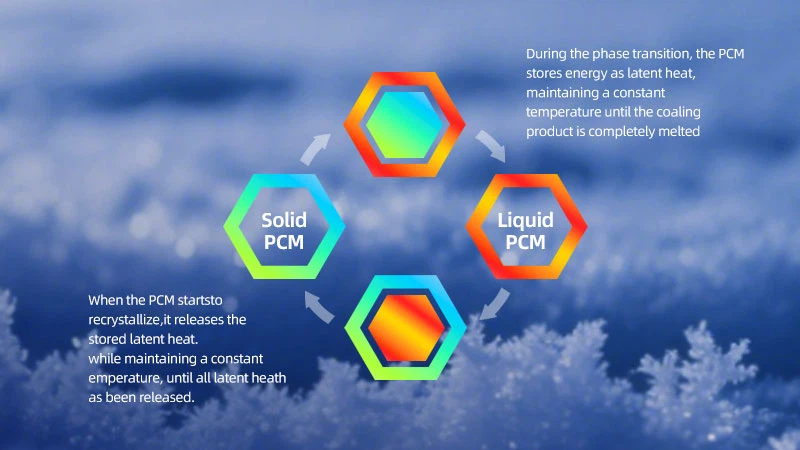
Compared with solid-liquid phase change materials, solid-solid phase change materials have many advantages. Solid-solid phase change materials can be directly processed and formed without the need for containers. They have a low coefficient of expansion and minimal volume change during phase change. They do not experience supercooling or phase separation, eliminating the need for anti-supercooling or anti-phase separation agents. They are also very low in toxicity and corrosive, leak-free, and environmentally friendly. They have a stable composition, good phase change reversibility, and a long service life. They are simple to install and easy to use. The main disadvantages of solid-solid phase change materials are their low latent heat of phase change and high price. Liquid-gas and solid-gas phase change involve large amounts of gas during the phase change process, resulting in significant volume changes. Therefore, despite their significant phase change heat, they are rarely used in practical applications.
II. Applications of Phase Change Materials
The development of phase change energy storage materials has gradually entered the practical stage, primarily for controlling reaction temperatures, utilizing solar energy, and storing waste heat from industrial reactions. Low-temperature energy storage is primarily used for waste heat recovery, solar energy storage, and heating and air-conditioning systems. High-temperature energy storage is used in heat engines, solar power plants, magnetohydrodynamic power generation, and satellites. Injecting these materials into textiles can create lightweight clothing with excellent thermal insulation properties. They can also be used to create thermos cups that retain heat longer than ordinary ceramic cups. Asphalt or cement pavements infused with this phase change material can prevent icing on roads and bridges. Therefore, it has broad application prospects in engineering insulation materials, healthcare products, aerospace equipment, military reconnaissance, and daily necessities.
(1) Applications of Phase Change Materials in the Medical Industry
Many medical electronic therapeutic devices require constant temperature operation, necessitating the use of temperature-controlled heat storage materials to maintain operating temperatures within acceptable limits. A Japanese patent reports the use of a mixture of NaSO₄10H₂O and MgSO₄7H₂O as a phase change material for instrument room temperature control, maintaining room temperature around 25°C. Specialty instruments can also be embedded in heat packs made of phase change materials to maintain operating temperatures. In recent years, a type of heat pack has become popular in the domestic market. Its phase-change material is a hydrated salt with a phase-change temperature of approximately 55°C. A metal sheet serves as a nucleation seed material. When the metal sheet is squeezed manually, its surface becomes the center of crystal growth, resulting in heat release during crystallization. Combined with a bag containing certain traditional Chinese medicines known to stimulate blood circulation, this creates a therapeutic effect, with some efficacy in treating diseases such as rheumatoid arthritis.

(2) Applications of Phase-Change Materials in Data Storage
PCM is a high-performance, non-volatile memory based on chalcogenide glass. These compounds have a crucial property: they change their resistance as they transition from one phase to another. The crystalline phase of the material is low-resistance, while the amorphous phase is high-resistance. Phase transitions are achieved by applying or removing current. Unlike traditional NAND-based non-volatile memory, PCM devices can support a virtually unlimited number of writes. PCM devices also offer advantages such as fast access response time, byte-addressability, and random read/write. It is one of many storage technologies touted as "changing the future." In 2017, a research team led by Song Zhitang, director of the Shanghai Institute of Microsystem and Information Technology, achieved a major breakthrough in novel phase-change memory materials. They innovatively proposed a design strategy for high-speed phase-change materials, minimizing the randomness of nucleation within amorphous phase-change thin films to achieve rapid crystallization. The Sc-Sb-Te-based phase-change memory device, fabricated using a 0.13µm COMS process, achieved a high-speed reversible write-erase cycle of 700 picoseconds and a cycle life of over 107 cycles. Compared to conventional Ge-Sb-Te devices, its operating power consumption was reduced by 90%, while maintaining comparable data retention for ten years. In 2018, memory chip manufacturer SK Hynix began production of PCM-based 3D crosspoint memory. SK explained that the 3D crosspoint memory cells used in SCM are made of sulfide-based phase-change materials. Recently, IBM research demonstrated that machine learning capabilities can be accelerated a thousandfold using analog chips based on phase-change memory. An IBM blog revealed that IBM is establishing a research center to develop next-generation AI hardware and explore the potential of PCM memory in AI applications.
