


If you work outdoors, exercise in hot weather, or spend long hours in a warm environment, staying comfortable can be a challenge. Traditional cooling methods, such as ice packs and fan-based systems, can help, but they may require frequent preparation, extra equipment, or regular maintenance.
PCM cooling vests offer another approach. They use Phase Change Materials (PCMs) to absorb heat and provide localized cooling without batteries or continuous water circulation.
But how exactly does this technology work? The answer lies in heat transfer and a process called latent heat absorption.
1. What Is a Phase Change Material (PCM)?
A Phase Change Material is a substance that absorbs or releases a considerable amount of thermal energy when it changes from one physical state to another.
In a PCM cooling vest, the material is typically designed to change from solid to liquid at a selected temperature. Common cooling applications use different transition temperatures depending on the intended environment and user requirements.
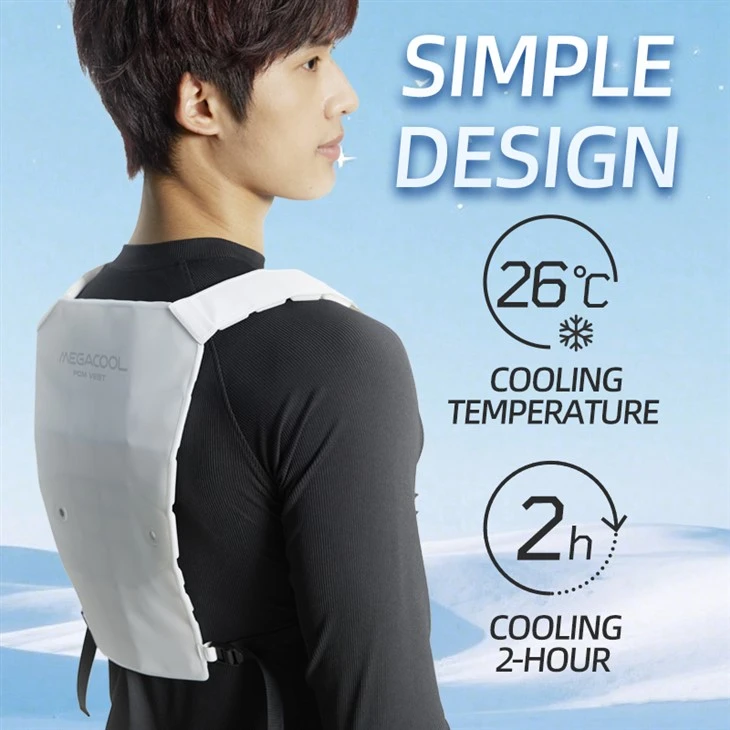
For example, some wearable cooling products use PCMs with transition temperatures between approximately 18°C and 28°C.
When the PCM is fully solid, it is ready to absorb heat. As the temperature around it rises, the material begins to melt. During this process, it absorbs latent heat while its temperature remains relatively close to its phase-change temperature.
This is what makes PCM different from an ordinary material that simply becomes warmer as it absorbs heat.
2. How Does Heat Transfer Work in a PCM Cooling Vest?
The main cooling mechanism of a PCM vest is heat absorption through direct thermal contact.
Here is how the process works:
Step 1: Heat moves from the body to the PCM pouch
When you wear a PCM vest, body heat transfers through the fabric and pouch wall toward the cooler PCM inside. This process is primarily driven by conduction.
The closer the PCM pouch is to the body, the more effectively heat can transfer, assuming the vest fits comfortably and does not restrict movement.
Step 2: The PCM absorbs latent heat
As the PCM absorbs heat, it gradually changes from a solid into a liquid. During this phase change, it can absorb a substantial amount of thermal energy without a large increase in temperature.
This allows the vest to provide relatively stable localized cooling while the phase change is taking place.
Step 3: The PCM gradually reaches its liquid state
Once the PCM has completely melted, its ability to absorb heat through that phase change is largely used up. The cooling effect will then decrease as the material continues to warm.
The cooling duration depends on several factors, including PCM quantity, transition temperature, latent heat capacity, ambient conditions, and the user's activity level.
3. Why Is PCM Different from Traditional Ice Vests?
Both ice and PCM absorb heat as they melt, but they have different phase-change temperatures.
Ice melts at approximately 0°C, which can be too cold for comfortable direct contact in wearable cooling applications.
PCM can be formulated to transition at a higher temperature, making it possible to select a cooling range more suitable for a particular application.
Here is a simple comparison:
| Feature | Traditional Ice Vest | PCM Cooling Vest |
|---|---|---|
| Cooling mechanism | Ice absorbs heat as it melts | PCM absorbs latent heat during phase change |
| Phase-change temperature | Approximately 0°C | Can be customized for different applications |
| Cooling experience | Can feel excessively cold initially | Can provide a more controlled temperature range |
| Preparation | Requires freezing ice or ice packs | Requires conditioning according to PCM specifications |
| Reusability | Reusable with proper preparation | Reusable after the PCM is returned to its solid state |
PCM does not automatically provide longer cooling than every ice-based product. Performance depends on the amount of cooling material, its thermal properties, and the conditions in which the vest is used.
4. How Does Vest Design Affect Cooling Performance?
The PCM itself is important, but the vest's construction also plays a major role.
PCM pouch placement
Pouches should be distributed to provide appropriate contact with the body. Their placement affects how heat transfers and how evenly the cooling effect is experienced.
Fabric and pouch materials
The outer fabric should provide suitable comfort, flexibility, and durability. The pouch material must also be compatible with the PCM and designed to contain it securely.
Fit and adjustability
A vest that fits properly helps maintain consistent contact between the cooling pouches and the body. Adjustable designs can accommodate different body shapes and clothing layers.
For example, the Adjustable PCM Cooling Vest offers an adjustable design for different wearing requirements.
Weight and mobility
For users who need to move frequently, vest weight and flexibility are important considerations. A lightweight construction can help improve wearing comfort during work or outdoor activities.
Megacool's Lightweight Phase Change Cooling Vest is one option to consider for applications where mobility and wearing comfort matter.
5. Choosing the Right PCM Temperature for Different Applications
Not every cooling application requires the same PCM transition temperature.
The appropriate temperature depends on the working environment, clothing layers, activity level, and desired cooling experience.
For example:
Indoor workplaces: A moderate transition temperature may be suitable for users working in warm warehouses, factories, or workshops.
Outdoor construction: Workers exposed to high temperatures may need a vest with a PCM formulation and capacity suited to their working conditions.
Sports and outdoor activities: Lightweight construction, flexibility, and freedom of movement may be particularly important.
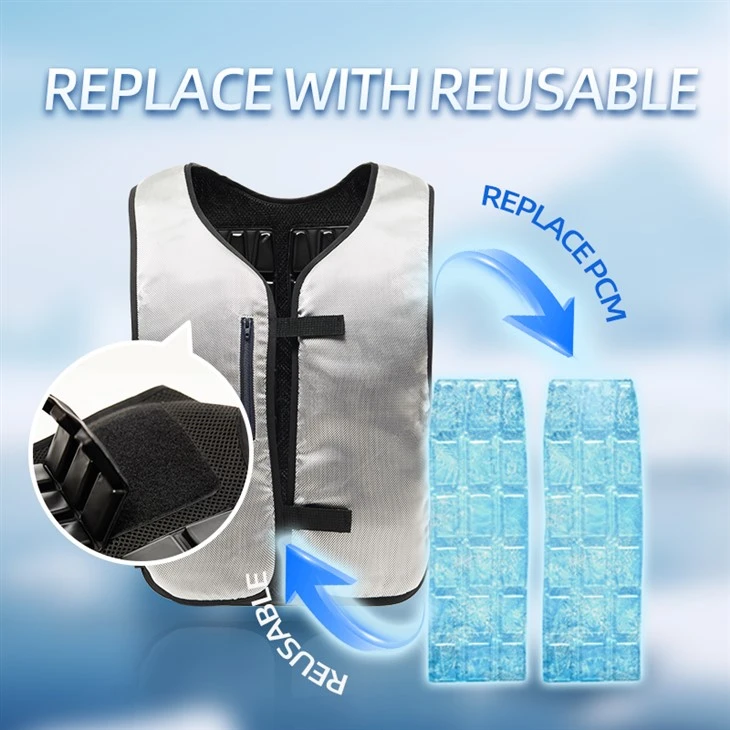
Long working shifts: PCM quantity, cooling duration, and the availability of replacement or reconditioning packs should all be considered.
For users who need cooling support in demanding working environments, the PCM Ice Pack Vest for Heat is another product option to explore.
The best approach is to select the PCM temperature and vest design according to the actual application rather than assuming one configuration works for everyone.
6. How Do You Recharge and Maintain a PCM Cooling Vest?
After the PCM has completely melted, it needs to be returned to its solid state before it can provide the same phase-change cooling effect again.
The required preparation method depends on the PCM formulation and its transition temperature. Some products require refrigeration, while others may need freezer conditioning.
Always follow the manufacturer's recommended preparation temperature and time. Avoid exposing the PCM pouches to temperatures outside their specified range.
For cleaning, follow the care instructions for the specific vest. If the PCM inserts are removable, take them out before washing the outer garment unless the manufacturer explicitly confirms that the complete vest is washable.
Proper storage and handling can help maintain the condition of both the PCM pouches and the vest fabric.
7. Final Thoughts
PCM cooling vests work through a straightforward but effective thermal principle: heat transfers from the body toward the cooler PCM, which absorbs latent heat as it changes from solid to liquid.
Unlike conventional ice packs that melt at 0°C, PCM formulations can be designed for different transition temperatures, allowing manufacturers to develop cooling products for a range of working and outdoor environments.
At Megacool, we offer PCM cooling vests in different designs and can discuss options such as PCM transition temperature, pouch configuration, vest materials, and OEM/ODM customization.
If you are sourcing cooling vests for workers, outdoor users, or sports applications, share your target environment and product requirements with our team. We can help you explore a suitable PCM cooling solution.